Product Design for Global Clinical Trial Technology
Context
Industry
Global clinical trial technology
Niche
Clinical trials software
Company Size
1200+
HQ
USA
Personal Focus Areas:
Role
I came on board as a product designer to help the eCOA and Pacient Data collection side of the business manage the increasing demands for improved pacient experience for the mobile application, eCOA questionnaires, study consent, as well as for the internal tooling that support the clinical trial teams and their operations.
Product Background
Trial participants
Clinical trial participants face complex questionnaires and consent processes that can be overwhelming and confusing, and that, at the same time, have to comply with demands set by regulatory bodies in several parts of the world. All of this, while going through their own personal challenges, caused by declining health, or by the side effects of the treatment they are receiving. The experience can be frustrating, and can lead to increased drop-out rates, and reduced engagement with the trial.
Trial site personnel
Clinical trial sites and staff face mounting challenges in keeping up with trial requirements, while managing day-to-day operations and patient care. They usually juggle with several ongoing studies, while managing day-to-day operations and patient care, and are often under pressure to meet strict timelines and regulatory requirements.
CROs and Sponsors
Clinical research organizations and sponsors face increasing pressure to deliver high-quality data while ensuring patient safety and regulatory compliance, all while managing costs and timelines. The pressure from competition is, who gets the drug on the market first, with the least amount of risks, side-effects, and costs.
These 3 dimensions give us the coordinates of the problem space that is defining the design challenges for this project, and that we will explore in the next section.
Limited pool of eCOA questionnaires
Risk for CROs and Sponsors:
- • Reduced flexibility in study design due to fewer ready-to-use questionnaires.
- • Higher risk of poor data quality and patient drop-off when forms feel complex.
Increased compliance
Risk for CROs and Sponsors:
- • Multi-country studies create layered regulatory requirements.
- • Non-compliance can delay timelines, increase costs, and damage credibility.
Multi-platform consistency
Risk for the company:
- • Merged product lines created inconsistent experiences across platforms.
- • Fragmented branding reduces trust and confuses customers.
Diverse patient populations
Risk for the patients:
- • Patients vary widely in digital literacy, health status, and accessibility needs.
- • Inclusive design is essential to reduce barriers and support better participation.
Increased cost-efficiency pressure
Risk for the company and research organizations:
- • Competitive market pressure demands lower costs without sacrificing quality.
- • Operational excellence must be preserved while timelines shrink.
AI adoption pressures
Risk for the company:
- • Delayed AI adoption can weaken competitiveness and slow market entry.
- • Missing AI opportunities can increase deployment costs and reduce study launch speed.
Role, team, and constraints
- Role
- Product designer
- Team
- Data Collection, eCOA, and internal tooling teams, all business-critical
- Constraints
- Ownership
- Led product design across multiple concurrent initiatives, partnering with product managers, engineers, and key stakeholders. NDA restrictions limit the sharing of specific implementation details.
- Contribution
- Product design for new questionnaires, shared design system components, shared design of the mobile and web application, AI skill design focused on wireframing and persona modelling, worked with product and engineering to define the solution structure
Research and key insights
Due to the project being under heavy deadlines to meet the release milestone, research activities were limited to desk research, SME interview and informal information gathering. The insights were used to inform the design decisions and to validate the proposed solutions.
Approach and decision points
[TODO: Describe the sequence of work and the decisions that shaped the direction. Include constraints, trade-offs, NDA limits, and recommendations that were accepted or rejected.]
Solution
To expand eligibility for clinical-trial studies, I contributed to several complementary product initiatives. Each addressed a different part of the platform, but together they increased the breadth, consistency, and operational readiness of the product suite, aligning towards the mission of delivering first-class experience to both trial patients and research organisations by reducing the burden on both patient and site staff.
eCOA Questionnaires Catalog
To help unlock new potential studies and clients, I designed several complex questionnaire types, as well as some of the features of the internal tooling that managed and delivered questionnaires, ensuring clarity, ease of use, and compliance with regulatory standards.
In-house study design platform
Helped redesign an internal study design platform that allows consultants to capture study requirements and configure them in the system more quickly, reducing time to launch and costs.
Patient Companion App
Extended the app to support web and tablet experiences, keeping the interaction model consistent across devices. Prioritized accessibility features for diverse patient needs.
ADA compliance
Being part of a highly regulated industry with high standards for accessibility, ensured all designs met or exceeded ADA compliance guidelines to accommodate users with disabilities.
Internal ticketing system
Helped design and implement an internal change-request ticketing system that gives site staff an easier way to handle patient requests for special data changes.
Artifacts
Prioritization and roadmap
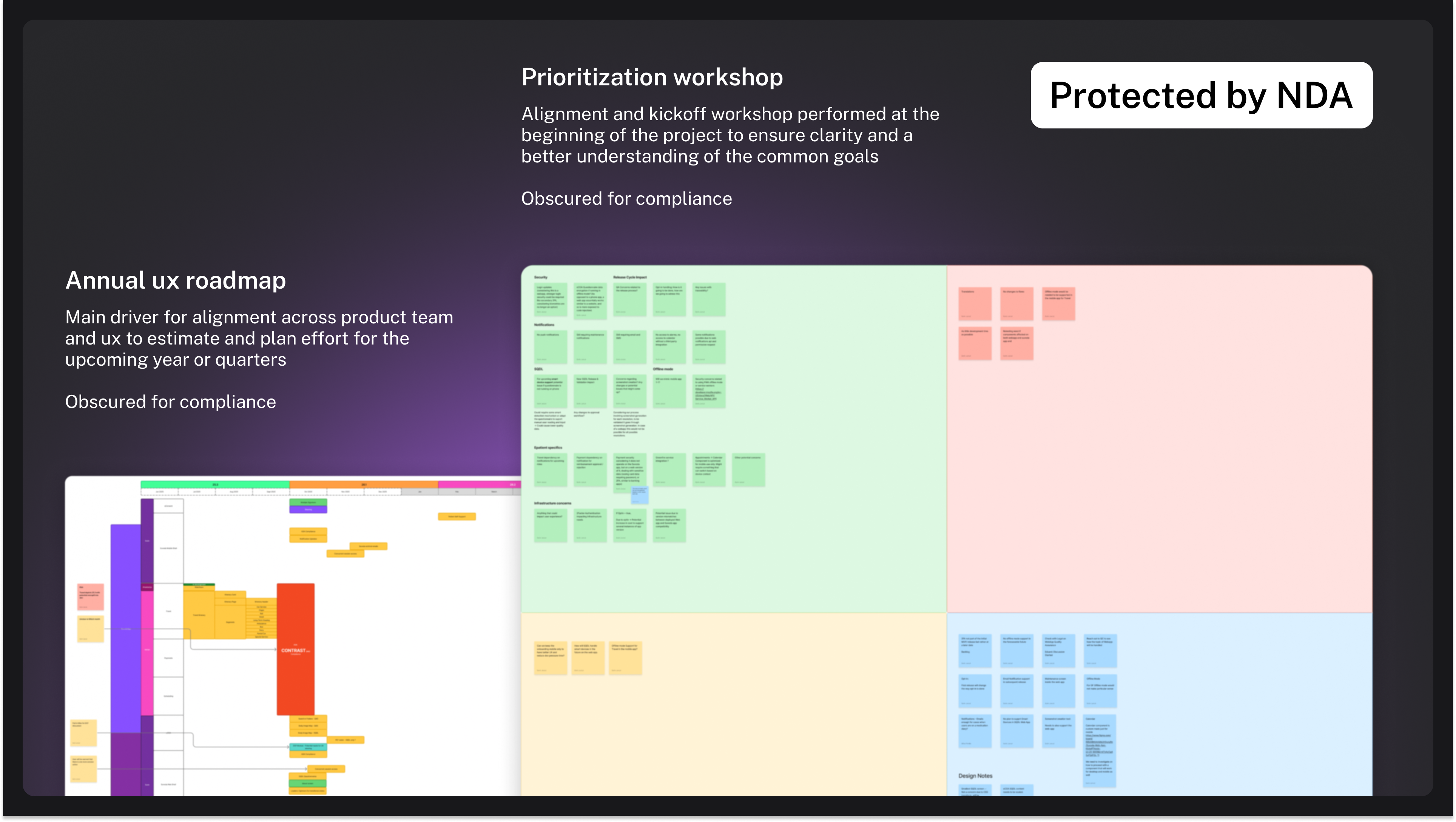
Alignment and kickoff workshop performed at the beginning of the project to ensure clarity and a better understanding of the common goals. Obscured for compliances
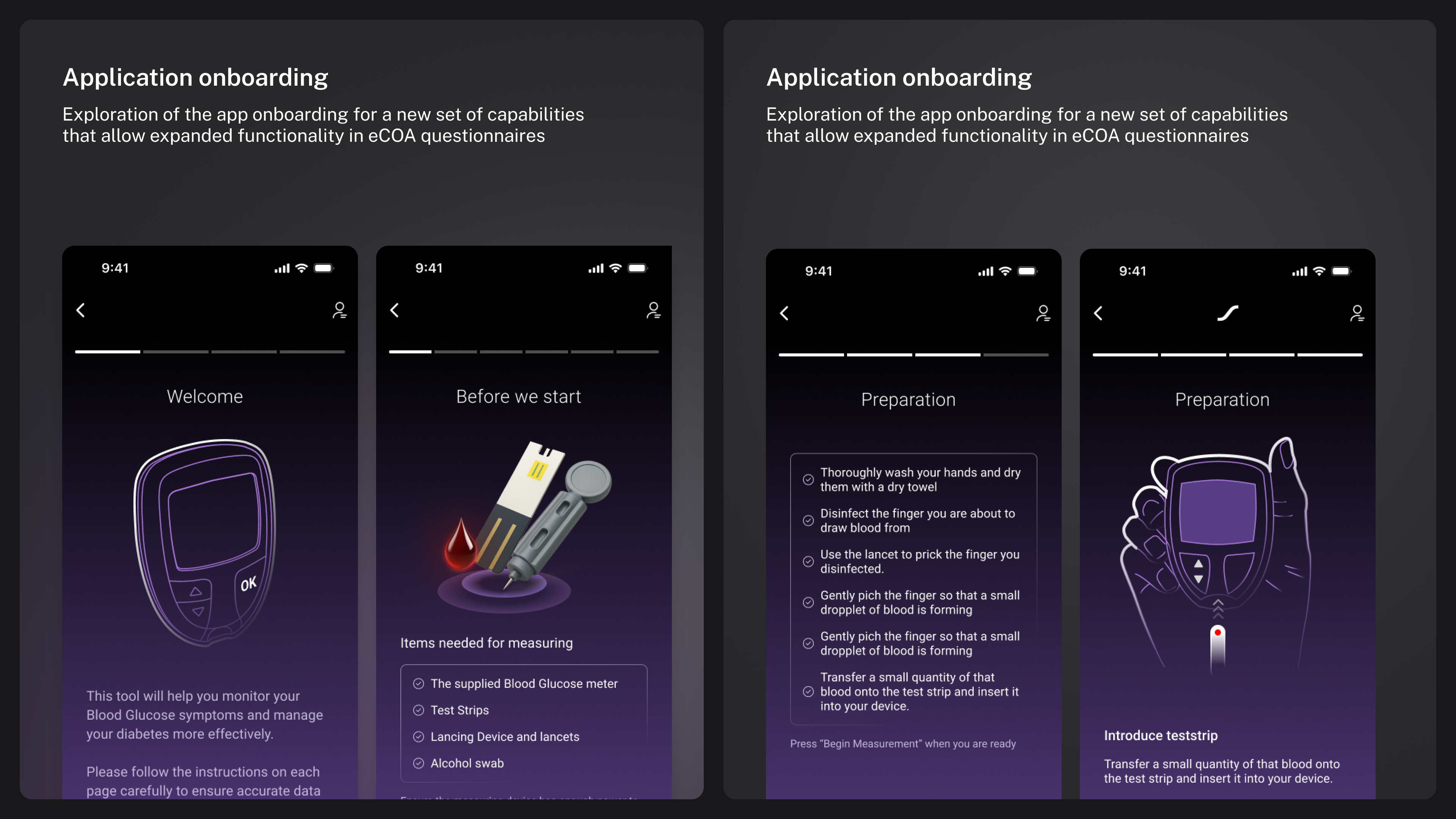
Mobile app special onboarding
Other artifacts
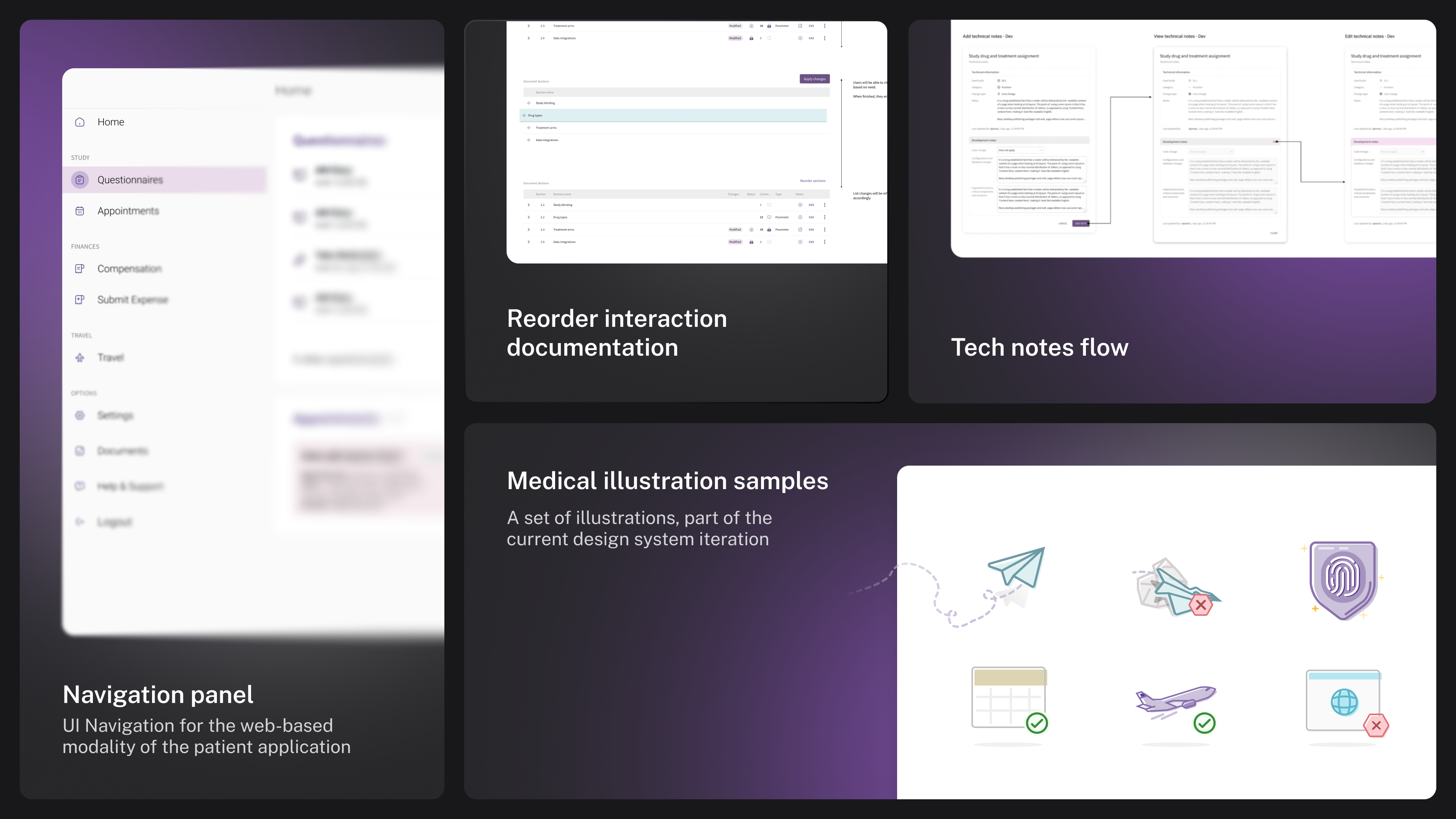
Visual assets
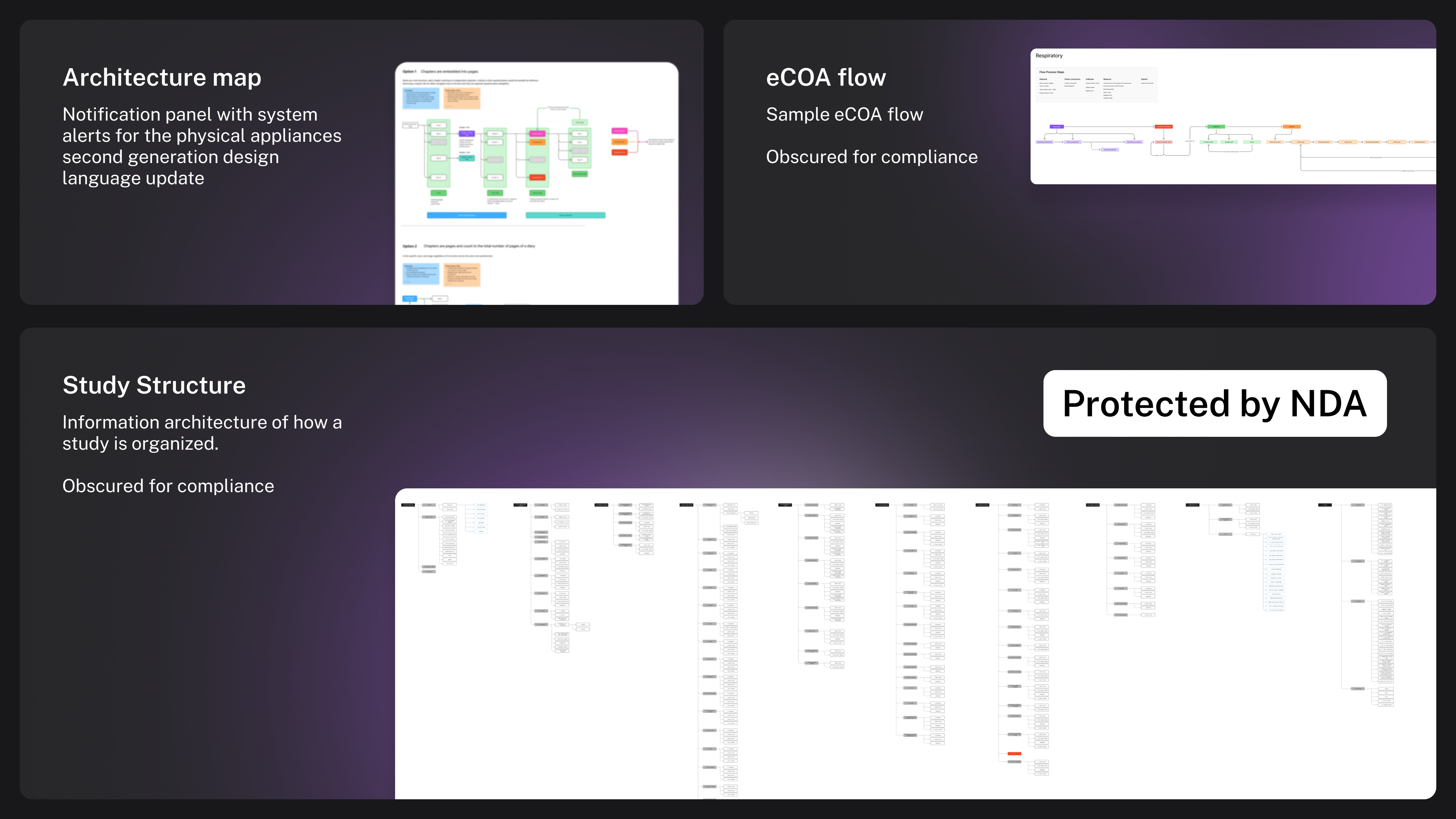
Information architecture and architecture maps
A dependency mapping concept to be used for a flow modelling functionality. Obscured for compliance.
User Flows
A complex section-based UI that is used to edit study specifications.
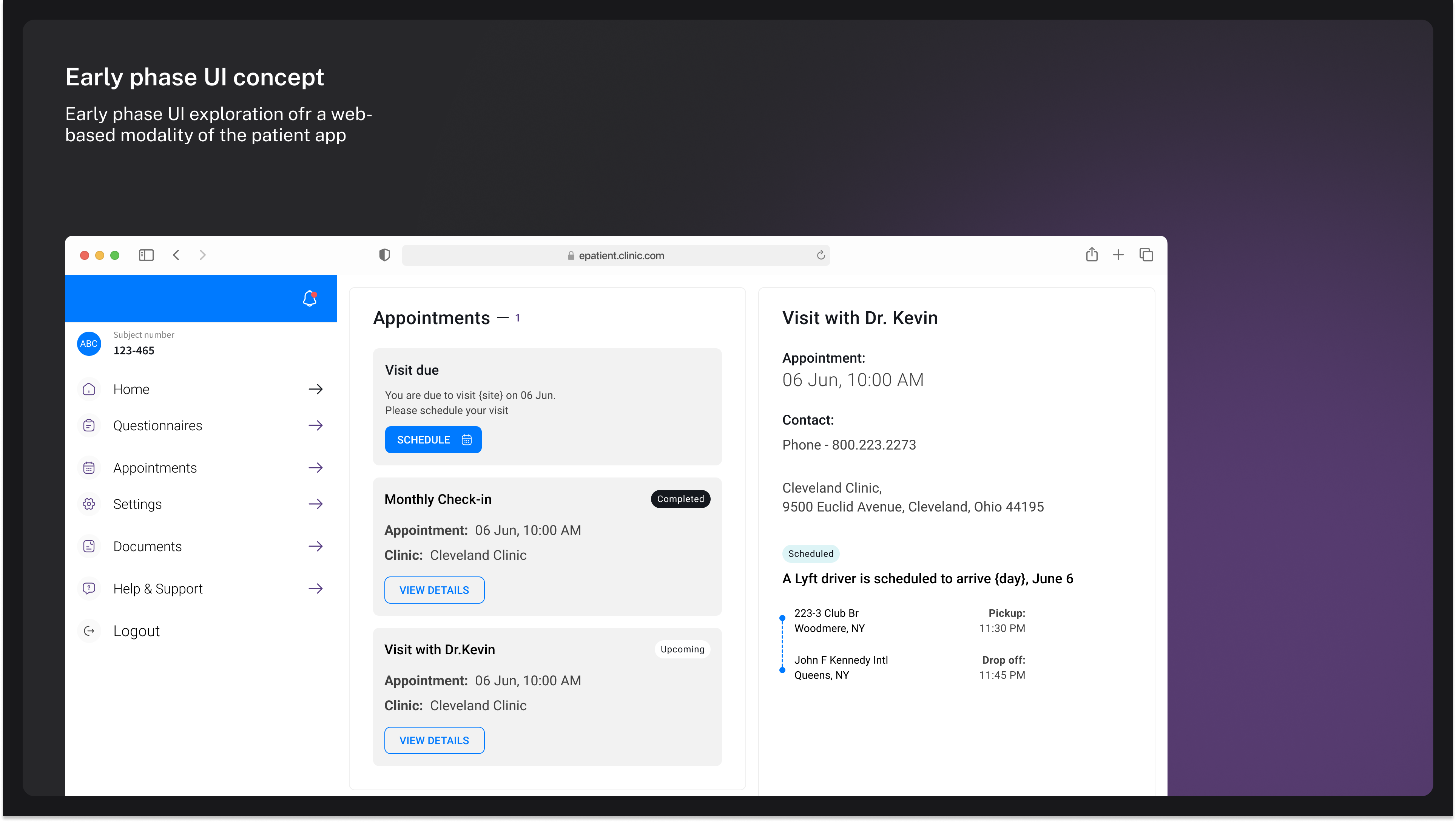
Early phase UI exploration ofr a web-based modality of the patient app
Impact
24% more signed studies observed
Higher number of eCOA Study types with advanced levels of customization made the company be the go-to partner for complex clinical trials.
90% ADA Compliance Score reported
A first pass ADA Compliance score of 90% after rigorously testing WCAG criteria, with outstanding issues mainly focused making code follow suite.
Improved AI accuracy observed
In the software development lifecycle process
An internal, consistent design system brought products closer together, increased product recognition, and reduced iteration.
18% more revenue reported
Per quarter
To quote, "best quarter to date" for the company in terms of eCOA sales, with increasing numbers each quarter.
Project Retrospective
Highlights
To quote, "best quarter to date" for the company in terms of eCOA sales, with increasing numbers each quarter.
Lessons Learned
To quote, "best quarter to date" for the company in terms of eCOA sales, with increasing numbers each quarter.